
Take Home Pay Calculator 2026 — Estimate Your Net Pay After Taxes
Our take home pay calculator instantly shows your exact net salary after federal income tax, state income tax, Social Security, and Medicare — in any of the 50 US states. Just enter your gross salary, select your state and filing status, and see how much you really take home, with no signup required. Whether you’re comparing job offers, planning a move, or simply want an accurate paycheck breakdown, our take home pay calculator makes it easy to understand your net pay by state for 2026. Free, fast, and always up to date.
Find out what you actually keep from your paycheck
Enter your salary below and see your exact take-home pay after federal tax, state tax, Social Security, and Medicare — for any of the 50 states.
Every tool you need to understand your paycheck
Free, fast, and accurate. No account, no spreadsheet, no guesswork.
Salary Calculator
Enter your gross salary and see exactly what you keep after federal tax, state tax, Social Security, and Medicare — for any of the 50 states.
Calculate my pay →State Comparison Tool
Compare your take-home pay across up to 3 states side by side. See exactly how much more you’d keep in Texas vs California vs New York.
Compare states →Tax Guides & Articles
Plain-English guides on federal tax brackets, state tax rates, how 401(k) saves you money, and how to compare job offers across states.
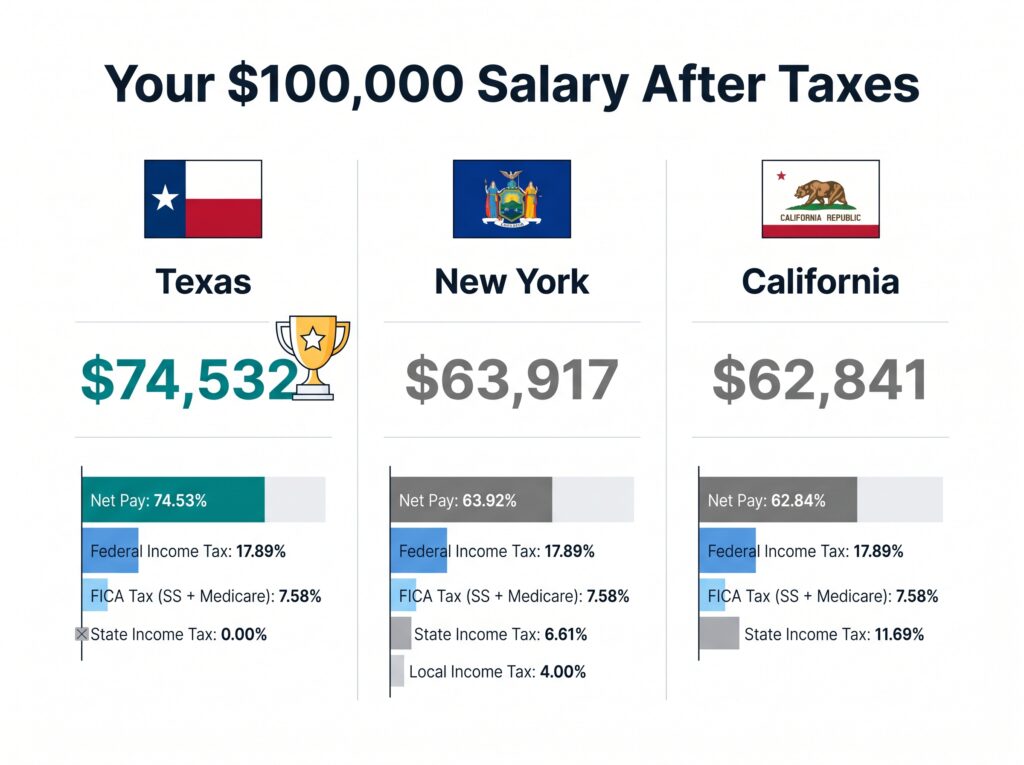
Read the guides →$100,000 salary — how much do you keep?
The same salary can mean $10,000+ more per year depending on which state you live in.
Try any combination of states with your own salary
Understand your money better
Plain-English guides on taxes, salaries, and what your paycheck really means.
9 States With No Income Tax in 2026 — And What It Means for Your Paycheck
Texas, Florida, Nevada and 6 others charge zero state income tax. Here’s how much you actually save.
California vs Texas: How Much More Do You Keep After Tax?
The same $100k salary can mean $11,000+ more per year in Texas. Here’s the full breakdown.
How Much Is a $100,000 Salary After Taxes? (By State, 2026)
Six figures sounds like a lot. Here’s what $100k actually looks like in every state after all taxes.
Common questions
Quick answers about take-home pay, taxes, and how our calculator works.
Ready to see what you really earn?
Free, instant, and no signup required. Your numbers stay in your browser.
How Much of Your Salary Do You Actually Keep? It Depends on Your State.
Your take-home pay calculator results depend on two things: federal taxes — which are the same for everyone — and state income taxes, which vary dramatically. While every American pays the same federal income tax rates, state income tax can add anywhere from 0% to over 13% on top of that. That difference is worth thousands of dollars every single year.
Our take-home pay calculator makes it easy to see exactly what you keep after all deductions. Enter your gross salary, choose your state, select your filing status, and get an instant breakdown of federal tax, state tax, Social Security, and Medicare. No spreadsheets, no guesswork — just your real net salary in seconds.
2026 Federal Tax Brackets: What You Actually Pay
The United States uses a progressive federal income tax system with seven brackets in 2026, ranging from 10% to 37%. The key thing most people misunderstand: your entire salary is not taxed at your highest bracket rate. Each bracket only applies to the income within that range. For example, if you earn $75,000 as a single filer, only the income above $48,475 is taxed at 22% — the rest is taxed at 10% and 12%.
After applying the standard deduction — $15,000 for single filers, $30,000 for married filing jointly, and $22,500 for head of household in 2026 — most Americans pay a much lower effective tax rate than their marginal bracket suggests. Use our free salary calculator to see your exact effective rate based on your income and filing status.
State Income Tax: The Biggest Variable in Your Take-Home Pay
State income tax is where your take-home pay by state varies the most. Nine states charge zero state income tax in 2026: Alaska, Florida, Nevada, New Hampshire, South Dakota, Tennessee, Texas, Washington, and Wyoming. If you live or work in one of these states, you keep significantly more of every paycheck compared to high-tax states.
On the other end of the spectrum, California has the highest state income tax rate in the country at up to 13.3% for top earners. New York reaches 10.9% at the highest bracket. Oregon, Minnesota, and New Jersey also rank among the highest-taxed states. For a $100,000 salary, the difference between living in Texas versus California can exceed $11,000 per year — money that stays in your pocket simply by crossing a state line.
How to Use the Take Home Pay Calculator
- Using our free paycheck calculator 2026 takes less than 30 seconds. Here is how it works:
- Enter your annual gross salary — the amount your employer pays before any deductions.
- Select your state from the dropdown — all 50 states are covered with 2026 tax rates.
- Choose your filing status: Single, Married Filing Jointly, or Head of Household.
- Optionally enter your 401(k) contribution percentage to see how pre-tax retirement savings reduce your taxable income.
- See your instant take-home pay breakdown — annual, monthly, and biweekly.
Our net salary calculator USA updates in real time as you type, so you can quickly compare different salary scenarios without clicking any buttons. Use the Compare States tool to see how your take-home pay changes if you move to a different state.
Social Security and Medicare: Understanding FICA Taxes
Beyond federal and state income taxes, every American worker pays FICA taxes — Social Security and Medicare. Social Security is taxed at 6.2% on wages up to $176,100 in 2026. Medicare is taxed at 1.45% on all wages, with an additional 0.9% surcharge on income above $200,000 for single filers or $250,000 for married couples filing jointly.
FICA taxes are the same regardless of which state you live in, which is why they show up as a separate line item in our take-home pay calculator. For a $75,000 salary, Social Security takes approximately $4,650 and Medicare takes approximately $1,088 — a combined FICA burden of $5,738 per year before any income taxes are applied.
How a 401(k) Reduces Your Take Home Pay — and Your Tax Bill
Contributing to a traditional 401(k) is one of the most effective ways to reduce your tax bill while building retirement savings. Every dollar you contribute to a pre-tax 401(k) reduces your federal taxable income by one dollar. The 2026 IRS contribution limit is $23,500 per year (or $31,000 if you are 50 or older with the catch-up contribution).
For example, if you earn $80,000 and contribute 10% ($8,000) to a traditional 401(k), your federal taxable income drops to $72,000 (minus the standard deduction). In the 22% bracket, that saves you approximately $1,760 in federal taxes alone — in addition to similar savings on most state income taxes. Use the 401(k) field in our salary calculator to model exactly how much you save.
Salary Calculator by State: Most Popular Comparisons
Our users most commonly compare these states when evaluating job offers or considering relocation. Click any link below to open the calculator pre-loaded for that state:
Texas Salary Calculator — No state income tax, one of the best states for take-home pay
California Salary Calculator — Highest state income tax in the US, up to 13.3%
New York Salary Calculator — Up to 10.9% state income tax plus potential NYC local tax
Florida Salary Calculator — No state income tax, popular destination for relocations
Washington Salary Calculator — No state income tax, home to major tech employers
Not sure which state gives you the best take-home pay? Use our state comparison tool to compare up to three states side by side with your exact salary. The results might surprise you — a lower nominal salary in a no-tax state can easily beat a higher offer in a high-tax state when you look at actual take-home pay.
Why Your Actual Paycheck May Differ From Our Estimate
Our take-home pay calculator provides a highly accurate estimate based on 2026 tax rates, but your actual paycheck may differ slightly for a few reasons. Our tool uses the standard deduction and does not account for itemized deductions, specific tax credits, or local city taxes. For example, New York City residents pay an additional local income tax on top of New York State tax. Philadelphia, Detroit, and several other cities also levy local income taxes that are not reflected in our calculations.
Additionally, employer-specific deductions — such as health insurance premiums, FSA contributions, life insurance, or union dues — will reduce your net paycheck beyond what our calculator shows. For a complete picture of your personal tax situation, we recommend consulting a licensed CPA or tax professional. For official IRS guidance, visit IRS.gov.